Neem - Nature's Healing Gift To Humanity by Ferlow Klaus
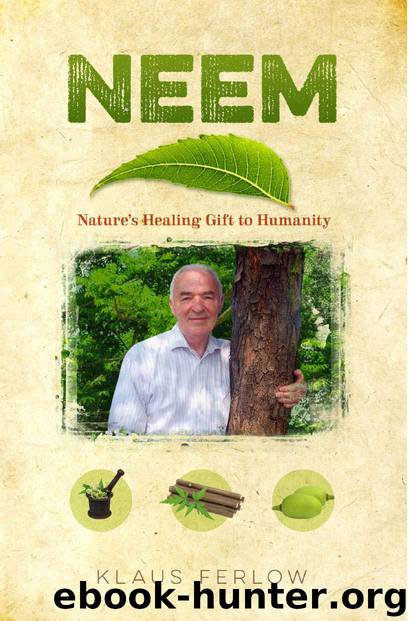
Author:Ferlow, Klaus [Ferlow, Klaus]
Language: eng
Format: azw3
Publisher: Neem Research
Published: 2017-04-25T16:00:00+00:00
Neem for Sustainable Development and Environmental Conservation:
An Indian Perspective
By: Dr. Ramesh C. Saxena The population of India has already crossed the one billion mark. Providing adequate food entitlements, safeguarding public health, meeting fuel and firewood needs, and at the same time preventing deforestation and conserving the environment, and slowing down the population growth will be daunting challenges in the coming decades.
55 Mbah, A. U., Udeinya, I. J., Shu, E. N., Chijioke, C. P., Nubila, T., Udeinya, F., ... & Obioma, M. S. (2007). Fractionated neem leaf extract is safe and increases CD4+ cell levels in HIV/AIDS patients. American journal of therapeutics, 14(4), 369-374.
Although "green revolution technologies" have more than doubled the yield potential of cereals, especially rice and wheat in India, these high input production systems requiring large quantities of fertilizers, pesticides, irrigation, and machines, disregard the ecological integrity of land, forests, and water resources, endanger the flora and fauna, and cannot be sustained over generations.
Future food security and economic development would depend on improving the productivity or biophysical resources through the application of sustainable production methods, by improving tolerance of crops to adverse environmental conditions, and by reducing crop and post-harvest losses caused by pests and diseases.
Appropriate technologies, which do not assault nature, would have key roles to play in ensuring food security, in improving public and animal health, and in rehabilitating the environment to safeguard its well being. The future must look to natural ways and process for augmenting agricultural productivity. In fact, all development efforts and activities, including pest management, should be within well-defined ecological rules rather than within narrow economic gains.
Sustainable agricultural systems must be efficient (i.e. effective and economically rewarding) and ecologically sound for long-term food sufficiency, equitable in providing social justice, ethical in respecting both future generations and other species, and also lead to employment and income-generating opportunities. For India, the use of neem may provide a key component in ensuring sustainable agricultural systems, including pest and nutrient management, animal health, human health, and environmental conservation.
Neem, a member of the Meliaceae family, is a botanical cousin of mahogany. According to a report of an ad hoc panel of the Board on Science and Technology for International Development, "this plant may usher in a new era in pest control, provide millions with inexpensive medicines, cut down the rate of human population growth and even reduce erosion, deforestation, and the excessive temperature of an overheated globe."
Neem's other descriptions, such as "nature's gift to mankind," "the tree for many an occasion," " the tree that purifies," " the wonder tree," "the tree of the 21st century," and "a tree for solving global problems," are a recognition of its versatility. Its botanic name, Azadirachta indica, derived from Farsi, "azad darakht i hindi" literally means the "free or noble tree of India," suggesting that it is intrinsically free from pest and disease problems and is benign to the environment.
Neem is an evergreen, tall, fast-growing tree, which can reach a height of 25m and 2.5m in girth. It has an attractive crown of deep green foliage and masses of honey scented flowers.
Download
This site does not store any files on its server. We only index and link to content provided by other sites. Please contact the content providers to delete copyright contents if any and email us, we'll remove relevant links or contents immediately.
Inner Engineering: A Yogi's Guide to Joy by Sadhguru(6799)
The Power of Now: A Guide to Spiritual Enlightenment by Eckhart Tolle(5789)
Fear by Osho(4742)
Ikigai by Héctor García & Francesc Miralles(4278)
The Art of Happiness by The Dalai Lama(4133)
The Ultimate Bodybuilding Cookbook by Kendall Lou Schmidt(3949)
Yoga Therapy by Mark Stephens(3750)
The Little Book of Hygge by Meik Wiking(3698)
The Healing Self by Deepak Chopra(3587)
Why Buddhism is True by Robert Wright(3459)
The Hatha Yoga Pradipika (Translated) by Svatmarama(3349)
Being Aware of Being Aware by Rupert Spira(3279)
Shift into Freedom by Loch Kelly(3202)
Wild Words from Wild Women by Stephens Autumn(3157)
Work Clean by Dan Charnas(3128)
Happiness by Matthieu Ricard(3052)
More Language of Letting Go: 366 New Daily Meditations by Melody Beattie(3032)
Yoga Body & Mind Handbook by Jasmine Tarkeshi(2881)
Why I Am Not a Feminist by Jessa Crispin(2764)
